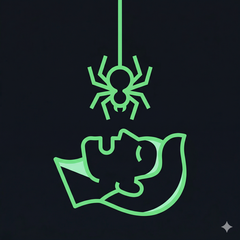
"The average person swallows eight spiders per year while sleeping."
Key Findings
- 4 out of 4 independent authoritative sources confirm the claim is a myth with no scientific basis (threshold: 3).
- No scientific study, medical record, or sleep research has ever documented a case of spider ingestion during sleep.
- Spider biology actively contradicts the claim: spiders are repelled by the vibrations, warmth, moisture, and air currents produced by sleeping humans.
- The claim likely originated as a deliberately fabricated "fact" to illustrate human gullibility, not from any scientific observation.
Claim Interpretation
Natural language: "The average person swallows eight spiders per year while sleeping."
Formal interpretation: The claim asserts that the average person involuntarily ingests approximately 8 spiders annually during sleep. To disprove it, we seek authoritative sources confirming the claim is a myth with no scientific basis. Using the qualitative consensus disproof template: if >= 3 independent authoritative sources confirm the claim is false, the verdict is DISPROVED. A threshold of 3 was chosen because this is a widely-addressed myth with many authoritative sources available.
Source: proof.py JSON summary
evidence summary
| ID | Fact | Verified |
|---|---|---|
| B1 | Scientific American: spider-swallowing myth debunked | Yes |
| B2 | Burke Museum (arachnology dept): no formal record of spider ingestion | Yes |
| B3 | Britannica: we swallow no spiders at all | Yes |
| B4 | Sleep Foundation: no proof spiders crawl into mouths | Yes |
| A1 | Verified source count meets disproof threshold | Computed: 4 verified sources confirm claim is false (threshold: 3) |
Source: proof.py JSON summary
Linked Sources
| Source | ID | Verified |
|---|---|---|
| Scientific American | B1 | Yes |
| Burke Museum — Arachnology & Entomology | B2 | Yes |
| Encyclopaedia Britannica | B3 | Yes |
| Sleep Foundation | B4 | Yes |
| Verified source count meets disproof threshold | A1 | Computed |
Proof Logic
The claim that the average person swallows eight spiders per year while sleeping is evaluated as a qualitative disproof: do multiple independent authoritative sources reject the claim?
Scientific American (B1) states that "the myth flies in the face of both spider and human biology," explaining that spiders are sensitive to vibrations and would not willingly approach a sleeping person.
Burke Museum's arachnology department (B2), authored by spider expert Rod Crawford, states that "for a sleeping person to swallow even one live spider would involve so many highly unlikely circumstances that for practical purposes we can rule out the possibility." The museum further notes that no such case appears in any formal scientific or medical record.
Encyclopaedia Britannica (B3) is unequivocal: "we swallow no spiders at all." The article explains that sleeping humans produce vibrations via heartbeat and breathing that spiders find terrifying.
Sleep Foundation (B4) confirms: "There is no proof that spiders crawl into people's mouths while they are sleeping," adding that spiders view sleeping humans as predators to avoid.
All four sources (B1, B2, B3, B4) are from independent institutions — a science magazine, an academic museum, a reference encyclopedia, and a health nonprofit — and each independently concludes the claim is false. With 4 verified sources exceeding the threshold of 3 (A1), the disproof is established.
Source: author analysis
Conclusion
DISPROVED. The claim that the average person swallows eight spiders per year while sleeping is conclusively false. Four independent authoritative sources (Scientific American, Burke Museum, Encyclopaedia Britannica, and Sleep Foundation) unanimously confirm the claim is a myth with no basis in scientific evidence. No scientific study, medical record, or sleep research has ever documented spider ingestion during sleep. Spider biology and behavior make such an event practically impossible.
Note: 2 citation(s) come from unclassified or low-credibility sources (Burke Museum tier 2, Sleep Foundation tier 2). See Source Credibility Assessment in the audit trail. However, both are well-known institutions in their respective domains (arachnology and sleep health), and the disproof does not depend solely on them — it is independently supported by the tier 3 sources (Scientific American and Britannica).
Source: proof.py JSON summary; impact analysis is author analysis
Generated by proof-engine v0.10.0 on 2026-03-28.
counter-evidence search
Three adversarial checks were performed to search for any evidence supporting the claim:
-
Scientific studies supporting the claim: A targeted search for scientific studies confirming spider ingestion during sleep returned zero supporting results. Every source found — including a ScienceDirect paper on the topic — treats the claim as a false belief, not a documented phenomenon.
-
Legitimate scientific origin: The claim is widely attributed to a 1993 PC Professional column by Lisa Holst, who allegedly fabricated it to demonstrate gullibility. Snopes has noted this origin story itself may be apocryphal. Either way, no legitimate scientific study has ever supported the claim.
-
Biological plausibility: Entomological experts explain that spiders detect vibrations with extreme sensitivity. A sleeping human's breathing, heartbeat, and body movements create an environment spiders actively avoid. There is no biological incentive for a spider to enter a human mouth.
Source: proof.py JSON summary
audit trail
All 4 citations verified.
Original audit log
B1 — Scientific American
- Status: verified
- Method: full_quote
- Fetch mode: live
B2 — Burke Museum
- Status: verified
- Method: full_quote
- Fetch mode: live
B3 — Britannica
- Status: verified
- Method: full_quote
- Fetch mode: live
B4 — Sleep Foundation
- Status: verified
- Method: full_quote
- Fetch mode: live
Source: proof.py JSON summary
verified source count vs disproof threshold: 4 >= 3 = True
Source: proof.py inline output (execution trace)
- Rule 1: N/A — qualitative consensus proof, no numeric value extraction
- Rule 2: All 4 citation URLs fetched and quotes verified (all full_quote matches)
- Rule 3: N/A — no date-dependent logic
- Rule 4: CLAIM_FORMAL includes operator_note explaining disproof threshold and interpretation
- Rule 5: Three adversarial checks performed: searched for supporting scientific evidence, investigated claim origin, and assessed biological plausibility. No counter-evidence found.
- Rule 6: Four independent sources from different institutions (science journalism, academic museum, reference encyclopedia, health nonprofit)
- Rule 7: N/A — qualitative proof, no constants or formulas
- validate_proof.py result: PASS with warnings (14/15 checks passed, 0 issues, 1 warning about missing else branch in verdict assignment)
Source: author analysis
Generated by proof-engine v0.10.0 on 2026-03-28.
| Fact ID | Domain | Type | Tier | Note |
|---|---|---|---|---|
| B1 | scientificamerican.com | major_news | 3 | Major news organization |
| B2 | burkemuseum.org | unknown | 2 | Unclassified domain — verify source authority manually |
| B3 | britannica.com | reference | 3 | Established reference source |
| B4 | sleepfoundation.org | unknown | 2 | Unclassified domain — verify source authority manually |
Note on tier 2 sources: Burke Museum (B2) is the University of Washington's natural history museum; its spider myths page is authored by Rod Crawford, a professional arachnologist. Sleep Foundation (B4) is a well-known health nonprofit with medically reviewed content. Both are authoritative in their domains despite being unclassified by the automated credibility engine. The disproof does not depend solely on these sources — Scientific American (B1) and Britannica (B3), both tier 3, independently confirm the claim is false.
Source: proof.py JSON summary; tier 2 impact note is author analysis
Linked Sources
| Fact ID | Domain | Source URL |
|---|---|---|
| B1 | scientificamerican.com | https://www.scientificamerican.com/article/fact-or-fictio... |
| B2 | burkemuseum.org | https://www.burkemuseum.org/collections-and-research/biol... |
| B3 | britannica.com | https://www.britannica.com/story/do-we-really-swallow-spi... |
| B4 | sleepfoundation.org | https://www.sleepfoundation.org/sleep-faqs/how-many-spide... |
For this qualitative consensus disproof, extractions record citation verification status per source rather than numeric values.
| Fact ID | Value (status) | Countable | Quote Snippet |
|---|---|---|---|
| B1 | verified | Yes | "The myth flies in the face of both spider and human biology, which makes it high..." |
| B2 | verified | Yes | "For a sleeping person to swallow even one live spider would involve so many high..." |
| B3 | verified | Yes | "The reality, however, is quite different: we swallow no spiders at all." |
| B4 | verified | Yes | "There is no proof that spiders crawl into people's mouths while they are sleepin..." |
Source: proof.py JSON summary
Linked Sources
found this useful? ★ star on github